

Which Five Scientific Disciplines Did Darwin Draw On To Develop His Thinking About Evolution?
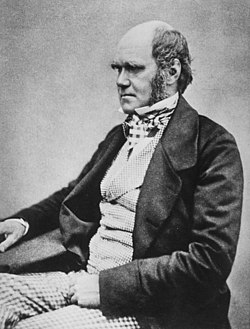
Charles Darwin, aged about 45
Charles Robert Darwin (12 February 1809 – 19 April 1882) was an English naturalist.[1] He was born in Shrewsbury, Shropshire. He is famous for his piece of work on the theory of evolution.
His volume On the Origin of Species in 1859. In this book, he put forward much testify that evolution had occurred. He also proposed natural selection as the manner evolution had taken place.
Darwin did not know about genetics: he never read the work of Gregor Mendel.[2] Even so, Darwin'southward caption of evolution was fundamentally right. In dissimilarity to Lamarck, Darwin's idea was that the giraffe's cervix became longer because those with longer necks survived better.[3] p177/9 These survivors passed their genes on, and in fourth dimension the whole species got longer necks.
Voyage of the HMS Beagle [modify | modify source]
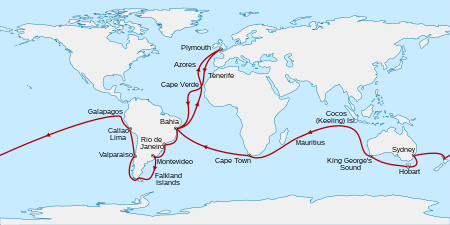
The voyage of the Beagle
Plymouth, England, s to Cape Verde and then southwest beyond the Atlantic to Bahia, Brazil, south to Rio de Janeiro, Montevideo, the Falkland Islands, circular the tip of South America then north to Valparaiso, Chile, and Callao. North westward to the Galapagos Islands before sailing west across the Pacific to New Zealand, Sydney, Hobart in Tasmania, and King George'due south Sound in Western Commonwealth of australia. Northwest to the Keeling Islands, southwest to Mauritius and Cape Boondocks, then northwest to Bahia and northeast back to Plymouth
Darwin spent almost v years on board a Royal Navy exploring ship, the HMS Beagle.[iv] He was the guest naturalist, which meant that he was responsible for making collections and notes almost the animals, plants, and the geology of the countries they visited. The transport's crew fabricated charts of all the coastal areas, which could be used by the navy wherever it went in the earth. At the fourth dimension, Britain had by far the largest navy in the globe, and an empire which was global.
Darwin collected everywhere the ship landed. He plant huge fossils of recently extinct mammals, experienced an earthquake in Chile, and noticed the country had been raised. He knew of raised beaches elsewhere, loftier in the Andes, with fossil seashells and trees which had one time grown on a sandy embankment. Obviously the earth was constantly changing, with land rising in some places, and sinking in others. He nerveless birds and insects, and sent shipments dorsum to Cambridge for experts to identify.
Darwin was the first dedicated naturalist to visit the Galapagos Islands, off the w declension of Ecuador. He noticed that some of the birds were like mockingbirds on the mainland, but different enough to exist placed in separate species. He began to wonder how so many new species came to be on these islands.
When Darwin got back to England, he edited a series of scientific reviews of the voyage, and wrote a personal journal which we know as The Voyage of the Beagle. It is one of the cracking natural history travel diaries.[5]
In 1843 Darwin, who already had two children with his wife Emma, bought Down House in the village of Downe, Kent. He lived in that location for the residuum of his life, and today the house and contents are open to the public.
Evolution [change | change source]
While on the H.M.S. Beagle, and later back home in London, Darwin had come up across the ideas of the Rev. T.R. Malthus. Malthus had realised that, although humans could double their population every 25 years, information technology did not happen in exercise. He thought the reason was that a struggle for existence (or resources) limited their numbers. If numbers increased, then famine, wars and diseases caused more deaths. Darwin, who knew that all living things could, in principle, increase their numbers, began to call up nearly why some survived, while others did not.[6] p264-268 His answer took years to develop.
The theory of evolution says that all living things on World, including plants, animals and microbes, come from a common ancestor by slowly changing throughout the generations. Darwin suggested that the way living things changed over fourth dimension is through natural choice. This is the better survival and reproduction of those that best fit their environment. Fitting into the identify where you live is called adapting. Those who fit best into the place where they alive, the best adapted, accept the best chance to survive and breed. Those who are less well-adapted tend not to survive. If they practise not survive well plenty to raise immature, this means they exercise not pass on their genes. In this way, the species gradually changes.
The outset chapter of the Origin deals with domesticated animals, such as cattle and dogs. Darwin reminded readers of the huge changes mankind had fabricated in its domestic animals, which were once wild species. The changes were brought nearly by selective convenance – choosing animals with desirable characters to brood from. This had been done generation afterwards generation, until our modern breeds were produced. Perhaps what human being had done deliberately, might happen in nature, where some would leave more offspring than others.
Darwin noticed that although young plants or animals are very similar to their parents, no 2 are exactly the same and at that place is e'er a range of shape, size, color, and then on. Some of these differences the plant or animal may have got from their ain ancestors, merely some are new and acquired by mutations. When such differences made an organism more able to live in the wild, it would have a meliorate take chances to survive, and would pass on its genes to its offspring, and they to their offspring. Whatsoever difference that would cause the plant or fauna to have less of a take chances to live would be less probable to be passed on, and would eventually die out altogether. In this way groups of similar plants or animals (called species) slowly change in shape and form so that they tin can live more successfully and accept more offspring who will survive them. Then, natural selection had similarities to selective breeding, except that it would happen past itself, over a much longer time.
He first started thinking almost this in 1838, but information technology took a full twenty years before his ideas became public. By 1844 he was able to write a typhoon of the master ideas in his notebook. Historians recollect that he did non talk about his theory considering he was afraid of public criticism.[7] He knew his theory, which did not discuss religion, raised questions virtually the literal truth of the Book of Genesis. Whatever the reason, he did not publish his theory in a book until 1859.[eight] In 1858 he heard that another biologist, Alfred Russel Wallace, had the same ideas nigh natural choice. Darwin and Wallace'southward ideas were kickoff published in the Journal of the Linnaean Order in London, 1858. And then, Darwin published his book the adjacent yr. The name of the book was On the Origin of Species by means of Natural Selection, or the preservation of favoured races in the struggle for life. This is commonly called The Origin of Species.[9] [10]

1859 copy of Origins of Species
Other works [change | change source]
Darwin wrote a number of other books, well-nigh of which are as well very of import.
His books [change | modify source]
- 1838-43: Zoology of the voyage of H.Thou.Southward. Beagle: published betwixt 1839 and 1843 in five Parts (and nineteen numbers) by various authors, edited and superintended by Charles Darwin, who contributed sections to two of the Parts:
- 1838: Part i No. 1 Fossil Mammalia, past Richard Owen (Preface and Geological introduction by Darwin)
- 1838: Part 2 No. 1 Mammalia, by George Robert Waterhouse (Geographical introduction and A notice of their habits and ranges past Darwin)
- 1839: Journal and remarks (The Voyage of the Beagle)
- 1842: The construction and distribution of Coral Reefs
- 1844: Geological observations of volcanic islands
- 1846: Geological observations on S America
- 1849: Geology from A manual of scientific inquiry; prepared for the use of Her Majesty'south Navy: and adjusted for travellers in general. ed. John Herschel.
- 1851: A Monograph of the Sub-form Cirripedia, with figures of all the species. The Lepadidae; or, Pedunculated Cirripedes. Living barnacles.
- 1854: A Monograph of the Sub-class Cirripedia, with figures of all the species. The Balanidae (or Sessile Cirripedes); the Verrucidae, etc.
- 1851: A Monograph on the Fossil Lepadidae, or, Pedunculated Cirripedes of Great Britain. Fossil barnacles.
- 1854: A Monograph on the Fossil Balanidæ and Verrucidæ of Keen Britain
- 1859: On the Origin of Species by means of natural selection, or the preservation of favoured races in the struggle for life
- 1862: On the various contrivances by which British and strange Orchids are fertilised past insects (Fertilisation of orchids)
- 1865: On the movements and habits of climbing plants (Linnean Order paper, published in book form in 1875)
- 1868: The variation of animals and plants under domestication
- 1871: The Descent of Man, and selection in relation to sex
- 1872: The expression of emotions in Man and animals
- 1875: Insectivorous plants
- 1876: The effects of cross and self fecundation in the vegetable kingdom
- 1877: The different forms of flowers on plants of the same species
- 1880: The ability of movement in plants
- 1881: The formation of vegetable mould through the activeness of worms.
[change | change source]
- Erasmus Darwin
- Alfred Russel Wallace
- Charles Lyell
- Charles Darwin'southward books
- Darwin Solar day
- Darwinism
- Evolution
References [change | change source]
- ↑ "Charles Darwin (1809 - 1882)". BBC. Retrieved 2011-11-03 .
- ↑ The work of Mendel was not rediscovered until the early 20th century
- ↑ Darwin, Charles 1884. The origin of species. sixth ed, Murray, London.
- ↑ Browne, Janet 1995. Charles Darwin: vol. 1 Voyaging, Part ii The Traveller. Cape, London. ISBN 1-84413-314-1
- ↑ Browne, Janet 1995. Charles Darwin: vol. ane Voyaging. Cape, London. ISBN 1-84413-314-ane
- ↑ Desmond A. & Moore J. Darwin. 1991. Joseph, London.
- ↑ Bowler, Peter J. 2009. Evolution: the history of an thought. fourth ed, Academy of California Press.
- ↑ Palca, Joe (2009). "Darwin's theory: likewise large to publish : NPR". npr.org.
- ↑ Browne, Janet 2002. Charles Darwin: vol. 2 The power of place. Cape, London. ISBN 0-7126-6837-iii
- ↑ Desmond, Adrian and Moore, James 1991. Darwin. Joseph, London. ISBN 0-7181-3430-3

Source: https://simple.wikipedia.org/wiki/Charles_Darwin
Posted by: freemantherwas.blogspot.com
0 Response to "Which Five Scientific Disciplines Did Darwin Draw On To Develop His Thinking About Evolution?"
Post a Comment